
Trophy Assets 🏆
Status as an industry

On some level, we all enjoy signalling and celebrating wins whether we pretend we’re above it or not. Holidays, art, expensive clothes: we like to front, treat ourselves, and spend when things have gone our way or when we feel good about our economic standing.
Some of these increased expenses can be simple improvements in one’s standard of living (e.g. paying off stressful debts, buying better quality food, employing a gardener to free up time). But often, surpluses flow into what we’ll collectively call trophy assets.
Some quick context…
Trophy assets, in the sense of buying things to signal something about yourself, purely exist because of our desire to play status games.
Status games describe the zero-sum social dynamic where individuals and groups compete or ‘signal’ their social standing within a society, community, or group—driven by our propensity to occupy positions within a hierarchy. Status also acts as a barometer for making snap judgements about people, similar to stereotyping; it doesn’t replace genuine value, it just makes it easier to ‘prove’ one’s value to others.
When viewed holistically, unconsciously playing status games and actually attaching self-worth to them is always a net-negative; they’re all pretty inconsequential when you take a step back. The true costs greatly outweigh the genuine benefits, yet we still have an evolutionary drive to play them. This doesn’t mean you have to submit to blindly competing but recognise the pull will always exist and you will never fully ‘kill’ that desire. Thinking you’re above status games is itself a form of status game… and usually you’re playing it unconsciously. But I digress, you’re not here for the platitudes.
The games we play—to gain approval, respect, or envy from others—can span the entire gamut, for better or worse. Curating a certain lifestyle on social media, signalling virtues such as piety or honour, or acquiring respected possessions (trophy assets), to mention but a few. It’s this last subset we’re focusing on today.
Journalist Robert Quillen defined ‘Americanism’ as “using money you haven’t earned to buy things you don’t need to impress people you don’t like”. That was written in 1928. Since then, ‘Americanism’ has arguably become western culture’s most ‘successful’ global export—only made more pervasive this century by the amplification of desire through social media platforms like Instagram and TikTok.
I’m not going to tell you what you should and shouldn’t spend your money on. Hopefully though, I can help familiarise you on the concept, show how to actually think about them as an asset class (hint: they’re more of a liability), and clarify my own thinking in the process.
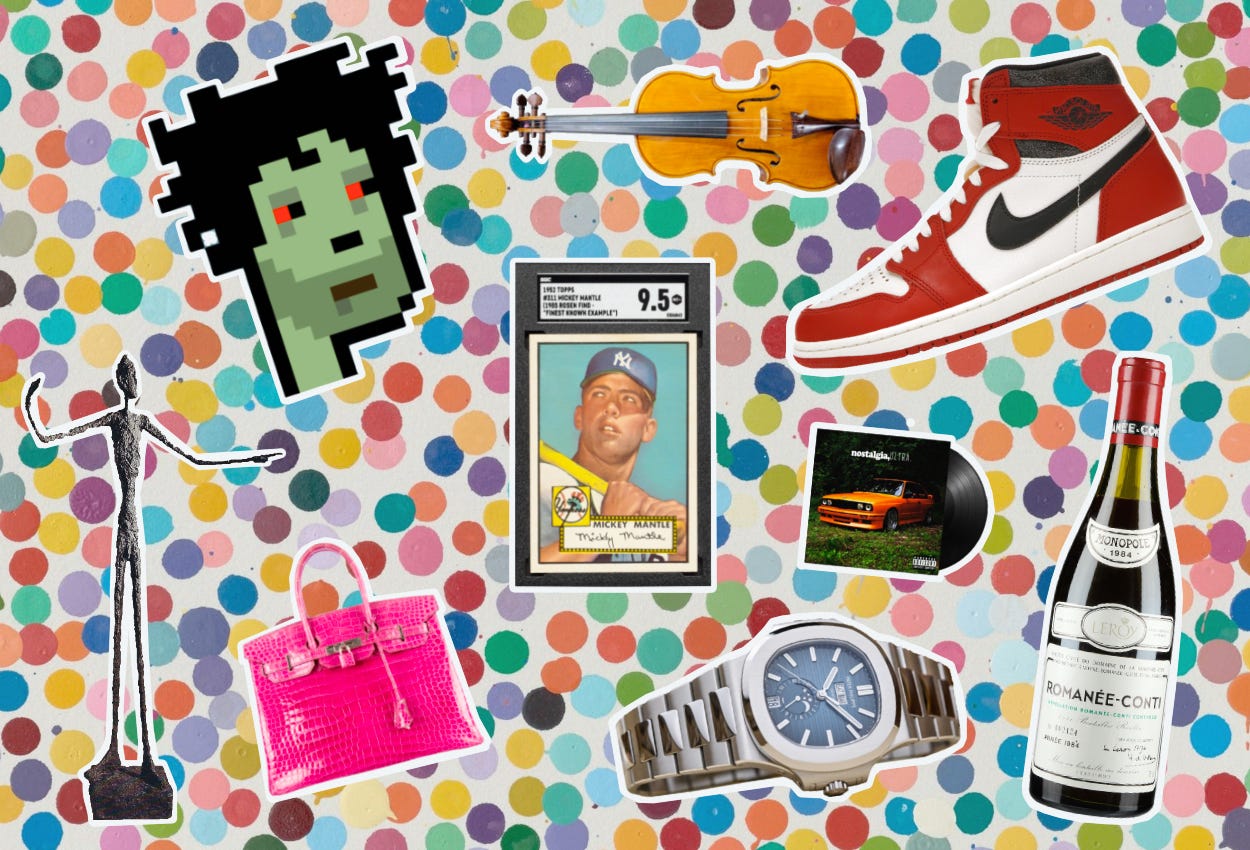
Trophy assets are more than just luxury items; they’re symbols of aspiration that aim to signal, “I’m doing well,” or “I belong here”. Framed this way, it quickly becomes apparent humanity has spawned many avenues aimed at satisfying this longing.
Penthouses, a Damien Hirst original, Cartier jewellery, châteaux, first-edition books, high-profile horses, vineyards, Patek Philippe watches, rare baseball cards, Giacometti sculptures, an ownership stake in Manchester United or the Dodgers, highly coveted records, Romanée-Conti wine, yachts, vintage ‘fast Fords’, rare Pokemon cards, Stradivarius violins, private islands, CryptoPunks. The list goes on.
Different communities, cultures, and generations ascribe value to different kinds of trophy assets. “One man’s rubbish is another man’s treasure” comes to mind.
Their designation also varies depending on wealth and peer groups—there are levels to this game. For the everyman, it might be limited-edition Jordans, designer handbags, or a new BMW. These items represent accessible ‘luxury’; expensive, possibly quite uncommon, but not unobtainium. For the billionaires and plutocrats of the world, exclusivity and inimitability are brought sharply into focus. Hawaiian islands and even stegosaurus skeletons are on the menu—essentially things no one else on the planet can possibly own.
It’s worth mentioning the concept of Veblen goods at this point as they form a large subset of trophy assets. Named after economist Thorstein Veblen, these goods do not adhere to the normal rules of supply and demand because the high prices are themselves a signal of wealth and status of the owner (and crucially, the common knowledge that others also know they’re expensive). The more expensive they are, the more demand tends to increase.
While Veblen goods can offer superior quality, this isn’t a given. Often, their value is purely symbolic, tied more to brand perception than to intrinsic value. I’m sure everyone knows instances of two similar-quality items commanding vastly different prices; one has a brand that evokes status, the other does not.
The perception of status comes at a price. If you’re playing that game, it can seem like a worthwhile deal. If you’re not, the mystique of the expensive item seems illusionary or even delusionary.
Not all trophy assets are Veblen goods, but all Veblen goods are trophy assets—they exist to signal respect and admiration.
This isn’t to say they are always intentionally bought as trophy assets. You might just love Porsche’s for how they handle round corners, or you might love a certain artist because their work genuinely speaks to you, but they do all signal status whether the buyer cares or not.
Now how to think of them as assets?
Any benefits beyond the signalling?
As we established earlier, people are drawn to signal status on some level, people like collecting things, and we’re told we’ll enjoy celebrating our wins with material purchases. This naturally leads to the desire to purchase trophy assets.
A common pitfall is that, to justify discretionary expenses, we convince ourselves they’re investments. It would be stupid of you not to buy it. You may wholeheartedly believe this, partly because of the money illusion (we forget to factor inflation into things), partly because we underestimate how well productive assets, such as stocks and rental property, perform over time. In a lot of cases, thinking your trophy assets are good investments is nothing but wishful thinking.
Watches, cars, and shoes are ‘investments’ for those that don’t understand this game.
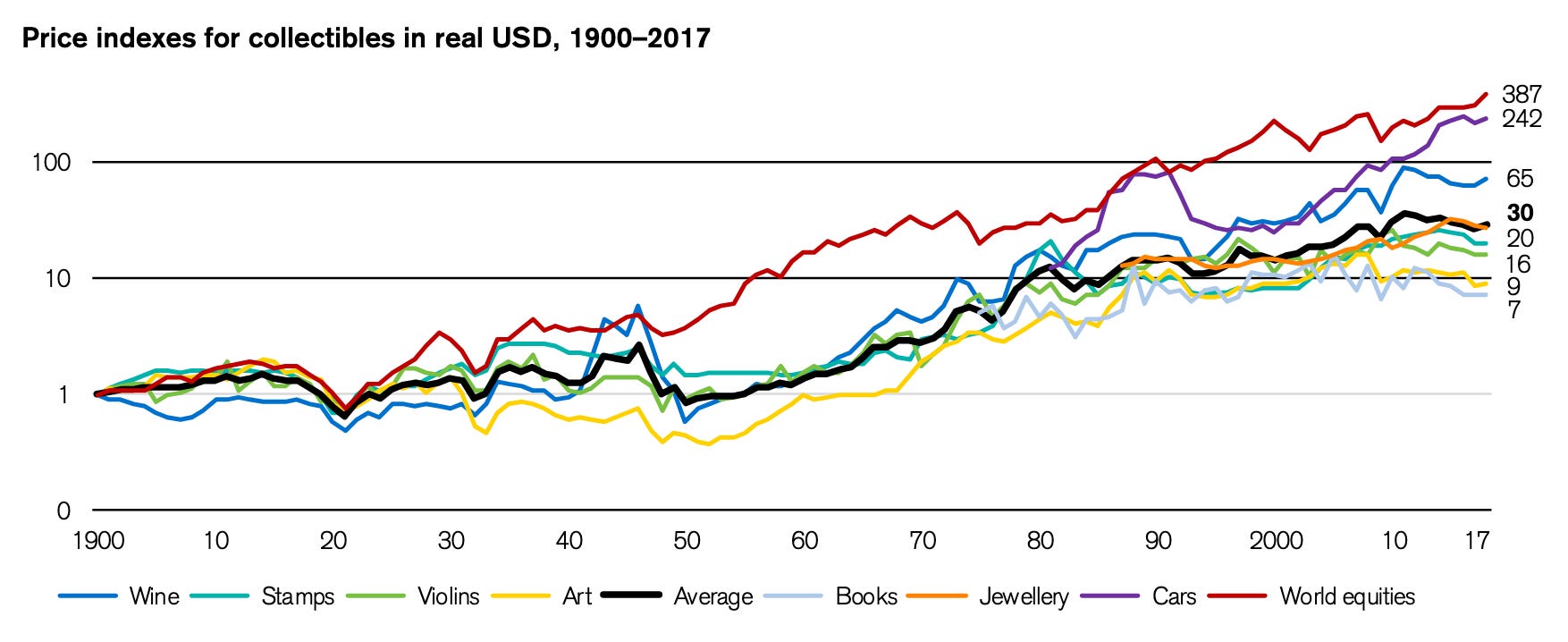
Just like personal property, these collectables are all unproductive (in the financial sense of the word). They produce no cashflows. And like personal property, they all inevitably underperform global stocks and other risk assets over time, most of them by an order of magnitude less. This isn’t even factoring in any potential storage costs, insurance costs, or transaction fees that mean the actual results are likely even lower than this data suggests. As anyone who has bought a home will know, these hidden fees shouldn’t be underestimated.
Naturally, some buyers will have outperformed global equities—especially those with genuine informational advantages or know-how of an industry—but most will have come out poorly.
There’s also heavy survivorship bias hidden in the data as the most desirable items are much more likely to survive the test of time and be cared for while everything else either rusts, decays, or just simply loses demand and becomes forgotten, taking them out the data.
Given the tangible nature and non-fungibility of this broad asset class, it’s virtually impossible to adequately index them like you can with traditional financial assets. There is no Trophy Asset Index one can buy, and even if one somehow existed, as the above chart attempts to illustrate, it would still likely underperform significantly. To be worth your time, you need to know exactly the right things to buy, operating akin to an active stock picker, rather than an indexer… and we know how difficult that is.
As with a lot of asset classes, extreme outliers drive the bulk of the returns, but because collectables are impossible to index, it means you can only own a fraction of what’s available. Thus, you'll likely fail to capture the outliers, and significantly underperform productive assets over the long-run.

If you still fancy your chances, the best returns have historically come from things that weren’t initially considered trophy assets upon their release—things that were originally priced as high-quality consumer goods such as Omega watches or excellent vintages of wine. Their initial value was tied more to their craftsmanship or quality but over time as these items gained cultural cachet (first watch on the moon anyone?), their status increased.
Add in a naturally decreasing supply alongside growing demand and prices could only rise; they were consumable goods after all. Few survived intact because most of them were used and worn and driven instead of being locked away in hermetically-sealed boxes. As a status-signalling item, they were underpriced, unlike many new luxury items we see today from LVMH and co.
However, the landscape for vintage trophy assets has changed significantly. Decades of cheap capital, the rise of nostalgia-baiting, and the increasing financialisation of almost everything have driven prices to levels that are now fairly efficient. The misguided idea that any and all of these items make solid investments has, ironically, further inflated prices, making future returns worse going forward.
This doesn't mean opportunity is entirely absent. We could see further demand increases as AI and robotics become a lot more prevalent in the production of goods. The value of human craftsmanship and connections to our analog past is very likely to increase. However, knowing which items will do well—while appearing easy in hindsight—is hard to predict ex ante.
Keen observers with a deep understanding of a specific niche might be able to identify future trophy assets but this will require anticipating shifts in cultural trends and an individual-mindedness to recognise currently under-appreciated items, much like how an astute investor identifies undervalued companies.
Beyond the individual items, it's crucial to understand that many trophy assets, particularly those tied to fashion or cultural trends, move in cycles. Consider the fluctuating desirability of vintage cars: pre-war models have given way to those from the '60s and '70s, which are now facing competition from '80s and '90s models. Similarly, the art world sees generational shifts in taste, with the demand for a Pollock or de Kooning potentially losing ground to the likes of Damien Hirst or XCOPY as younger collectors enter the market.
These cycles are often fuelled by nostalgia. As individuals reach their peak earning potential, they may seek to acquire the status symbols they admired in their formative years. This surge in demand, driven by a desire to recapture a piece of the past, inevitably drives up prices. However, as a new generation matures and establishes its own cultural icons, demand for the previous generation's trophy assets tends to wane.
Complementing the longer-term generational cycles, prices also exhibit shorter-term fluctuations tied to the broader economy. Typically, there's a lag of 6 to 18 months between changes in economically-sensitive metrics and corresponding shifts in trophy assets. Factors like real wage growth, the performance of speculative assets (such as crypto), and overall economic and risk-taking sentiment can all influence demand so being able to navigate macro environments well can be very useful.
We saw this play out during the broad boom in trophy assets during the Covid era—NFTs, watches, Ferrari’s, you name it, everything was going up. Almost all of them saw their zenith in 2022 after global markets (and economic euphoria) peaked the year previous. This period was characterised by pent-up pandemic-induced demand, easy financial conditions, and buoyant economic sentiment that pushed up prices well beyond sane valuations.
If you’re trying to value any asset, trophy or otherwise, correctly anticipating both the longer trends and short-term cycles is paramount. Executing this well is much harder than I’m making it sound, but the idea is to ride the wave of the longer trends, and be ready for turns in the shorter-term cycles.
As with any market, the worst time to be buying something is when everyone around you is celebrating and wanting to do the same. In the context of trophy assets, this means looking beyond the current hype and perhaps recognising that sometimes the best decision is to simply walk away.
“Don’t always go through the tiny door everyone else is trying to rush through; maybe go around the corner and through the vast gate that no one’s taking” — Peter Thiel
I’ll leave you with this: trophy assets are only ever a good potential investment if you have an edge in a particular market—exactly the same principle as picking individual stocks or crypto. If you have special access to limited-edition releases, if you know how to value Spanish wine better than most, if you can fix cars yourself and add value to them, they might make good investments.
For the vast majority who don’t have an edge, think of them as liabilities that may keep up with inflation if you’re lucky. If you get enjoyment from the item, and it retains its value against inflation, you’ve done better than most, but spare pretending it’s a great financial decision.
Brands will happily prey on our temptation to think anything remotely costly is an investment, and look to reinforce that perception at every opportunity, but this is an underhanded trick. Most people who bought a Rolex in 2022 thinking they were great investments have been played as fools… by Rolex.
Unless you really know a specific item or market, just buy things you can afford that you’d still want to buy even if you couldn’t show or tell anyone else about them, and enjoy them for what they are; forms of consumption, futile attempts to fill the void.
Open that bottle when the occasion calls for it, drive the Porsche on your Sunday afternoons, put the artwork on display for people to enjoy, wear the watch. Enjoy them for them and just put the money you want to invest into genuine assets.